The 9th Southern African Development Community (SADC) Industrialisation Week has been a demonstration of the power of regional cooperation through robust discussions, practical exchanges and new partnerships, with renewed collective commitment to advance the SADC Industrialisation Strategy and to build a region that is resilient, sustainable and inclusive.
This is according to the Deputy Director General (DDG) of Trade at the Department of Trade, Industry and Competition (the dtic), Ambassador Xolelwa Mlumbi-Peter, who made remarks at the closing ceremony of the week-long SADC Industrialisation Week held at the Durban International Convention Centre (ICC). The South African government hosted the event in partnership with the SADC Business Council and the SADC Secretariat.
It supports the implementation of the SADC Industrialisation Strategy and Roadmap (2015 – 2063), which is anchored on three pillars: industrialisation, competitiveness and regional integration.
Hosted under the theme, “Resilient, Sustainable and Inclusive Industrialisation through Infrastructure Development, Agricultural and Critical Minerals Transformation in Pursuit of a Just World”, it is a high-level precursor to the 46th SADC Summit of Heads of State and Government.
Among some of the key declarations made at the conclusion are a commitment to promote beneficiation and local processing of critical minerals and agricultural products to maximise regional economic value, mobilise greater public and private investment in industrial infrastructure, including energy, transport, logistics, digital connectivity and industrial parks. In addition, the meeting pledged to strengthen regional industrial value chains to increase production, value addition, intra – SADC trade and industrial competitiveness.
Mlumbi Peter emphasised that the success of the meeting will be measured by how effectively the declarations and recommendations emanating from discussions are implemented.
“We will work closely with the SADC secretariat to develop a roadmap that will help translate the outcomes into concrete actions that create jobs, expand regional value chains and improve the lives of our people. We must consistently be mindful of the fact that sustainable industrial development cannot be achieved by governments alone; strong partnerships between governments, the private sector, development finance institutions, academia, research institutions and development partners remain essential for mobilising investment, supporting innovation and accelerating implementation of regional industrial priorities,” she added.
The SADC Deputy Executive Secretary Ms Angele Makombo N’tumba concurred that the ideas shared at the meeting must now be translated into practical programmes, bankable projects and measurable results.
‘Our citizens will judge our success not by the quality of our discussions, but by the industries we establish, the jobs we create, the technologies we develop and the opportunities we provide for future generations. Industrialisation is not a competition among Member States. It is a shared regional journey where each country contributes its comparative advantage while benefiting from a larger, integrated regional market,” she added.
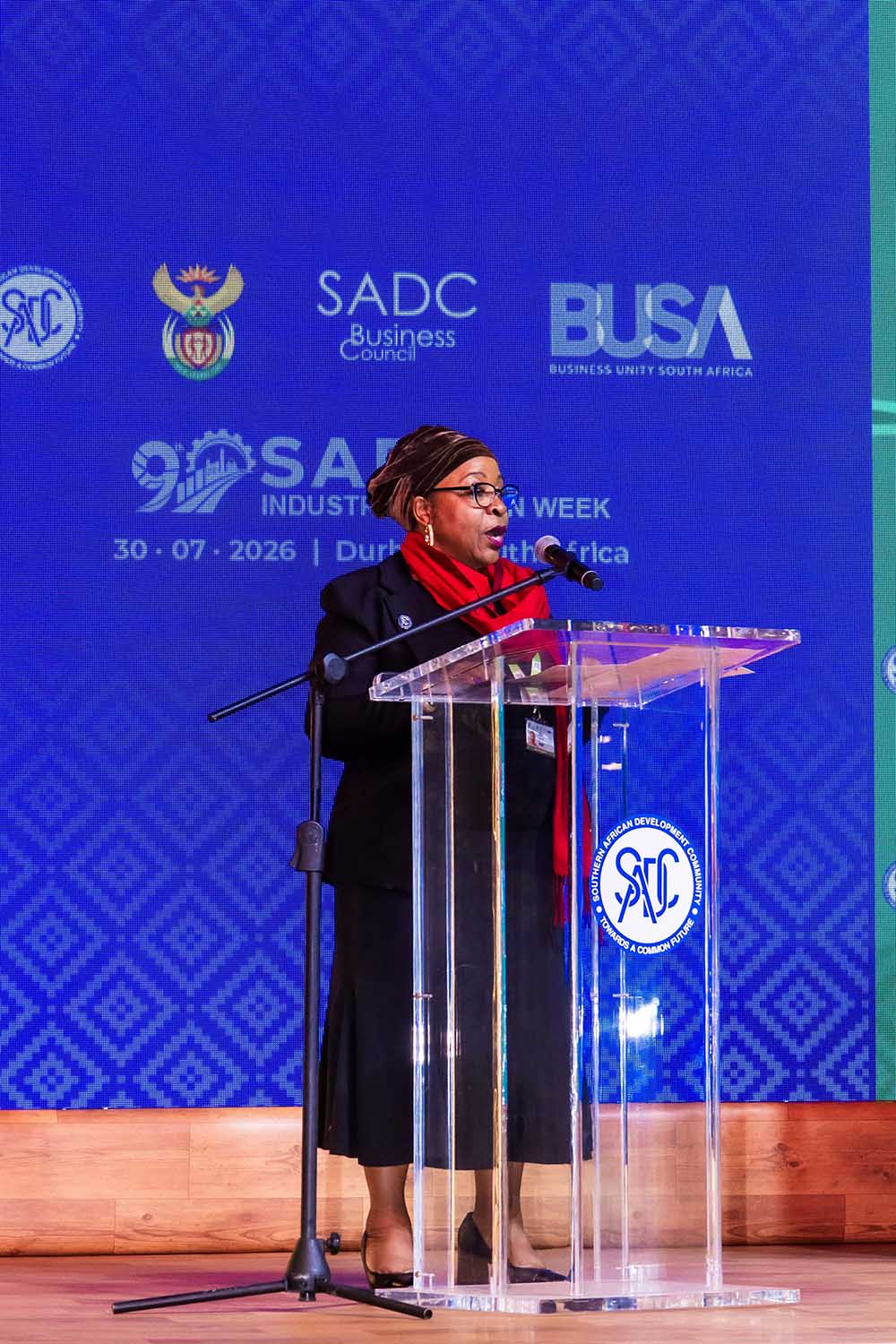
The Southern African Development Community Deputy Executive Secretary, Ms Angele Makombo N’tumba addressing delegates at the closing ceremony of the SADC Industrialisation Week hosted at the ICC in Durban.
Media Enquiries:
Bongani Lukhele – Director: Media Relations
Tel: (012) 394 1643
Mobile: 079 5083 457
WhatsApp: 074 2998 512
E-mail: BLukhele@thedtic.gov.za
Issued by: The Department of Trade, Industry and Competition (the dtic)
X: @the_dtic
Facebook: https://www.facebook.com/thedti?mibextid=ZbWKwL
YouTube: https://www.youtube.com/@thedtic
Website: https://www.thedtic.gov.za/
Share this:
