
The Chief Director of Space Affairs at the Department of Trade, Industry and Competition (the dtic), Ms Nomfuneko Majaja says developing countries do not have to begin their participation in the space economy with the most capital-intensive segments of the value chain.
Majaja was speaking during a panel discussion on the space economy hosted by the United Nations Committee on Trade and Development (UNCTAD), in partnership with the United Nations Office for Outer Space Affairs during the 9th World Investment Forum, which took place in Doha, Qatar from 25-27 October 2026.
The conference brought together government senior leaders and Chief Executive Officers from companies across globe. It provided an important platform to discuss emerging opportunities within the global space economy and developing countries’ potential contribution to their growth. Her presentation positioned Africa’s space economy as both a developmental instrument and an emerging industrial opportunity.
“Developing countries do not necessarily have to begin their participation in the space economy with the most capital-intensive segments of the value chain. There are significant low-hanging fruit opportunities according to their development levels that can generate immediate economic and developmental value, those in Earth Observation (EO), geospatial applications, processing space-based data through artificial intelligence, data analytics and digital services,” said Majaja.
She added that processing such data provided considerably greater recurrent commercial value and solutions that respond directly to the needs of governments, industries and communities.
Majaja highlighted that the downstream and value-added services provided particularly important opportunities for emerging economies, as countries do not necessarily need to own or operate extensive satellite infrastructure to participate meaningfully in the space economy.
“Existing satellite datasets can be transformed into decision-support tools and commercial applications for areas such as agriculture and food security, water resource management, mining, infrastructure planning, environmental monitoring, disaster management, climate resilience, insurance, logistics, urban development and municipal service delivery,” noted Majaja
She stressed that these capabilities were increasingly important as countries confront severe weather events, floods, droughts and other climate-related challenges.
“They are equally relevant to the management of Africa’s natural and mineral resources, agriculture and food security, infrastructure planning, border management and security, logistics, insurance disaster management and broader public-sector decision-making,’ she emphasised.
Majaja further highlighted opportunities for South Africa to deepen its participation in the manufacturing and componentry segment of the space value chain.
“South Africa already possesses industrial, engineering and technological capabilities that can be further developed and commercialised to increase domestic participation in satellite and space-system value chains, while creating opportunities for localisation, industrial scaling and exports. Such opportunities are equally possible for others developing countries,” she said.
In the short to medium term, she identified higher-value opportunities in Earth Observation, geospatial services, AI-enabled data analytics, component manufacturing and ground-based infrastructure and services.
Looking further ahead, Majaja noted that indigenous launch capability remains an important strategic opportunity on the horizon. While launch capability is capital-intensive, technologically demanding and requires significant infrastructure, skills and investment, its development would strengthen Africa’s participation across a much broader portion of the space value chain and contribute to greater technological and strategic autonomy.
She stressed, however, that a competitive space economy cannot develop through technology alone. Regulatory certainty and an effective government institutional framework are fundamental enablers of investment and sustainable industry development, which she emphasised that this was what the dtic, working with the South African Council for Space Affairs, were striving to achieve.
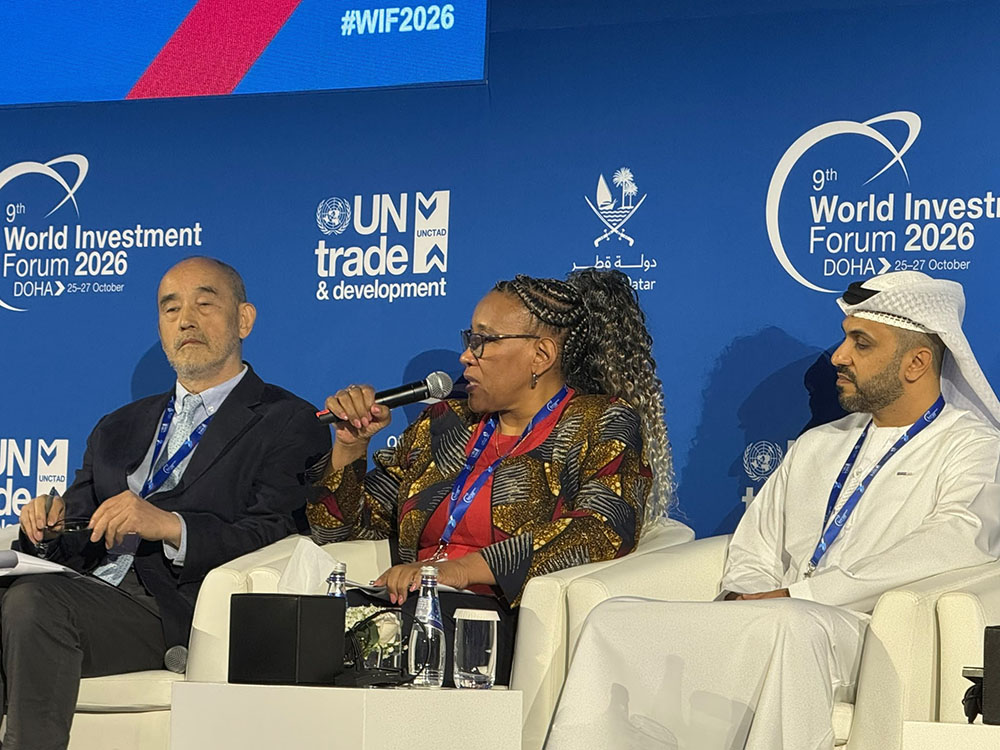
Caption: The Chief Director of Space Affairs at the Department of Trade, Industry and Competition (the dtic), Ms Nomfuneko Majaja speaking at the 9th World Investment Forum in Doha, Qatar
Media Enquiries:
Bongani Lukhele – Director: Media Relations
Tel: (012) 394 1643
Mobile: 079 5083 457
WhatsApp: 074 2998 512
Email: BLukhele@thedtic.gov.za or Mediarelations@thedtic.gov.za
Issued by: The Department of Trade, Industry and Competition (the dtic)
Follow us on X: @the_dtic
Share this:
