
The 4th national Timber in Construction Conference highlighted significant progress and growth in the sector, with new buildings, products, and practices celebrated by all stakeholders in attendance. The conference, held under the theme Connected by Timber: From Forests to Future Cities, was hosted by the University of Pretoria (UP) and the Pretoria Institute for Architecture. in partnership with the Department of Trade, Industry and Competition (the dtic),
The conference marked a highly successful, on-going collaboration between the dtic and stakeholders of the Master Plan for the Commercial Forestry Sector. This collaboration is focused on implementing the Master Plan’s vision of promoting economic growth and job creation within forestry value chains in South Africa, with a specific focus on promoting the widespread adoption of timber construction.
The conference highlighted projects using timber from across the country, ranging from affordable housing in Langa, Cape Town, multi-storey apartment and commercial buildings in Rosebank, Johannesburg, a 5-star hotel in Plettenberg Bay, to Premier Foods’ new flour mill in Fort Jackson, Kugompo City.
Speaking at the conference, the Deputy Minister of Trade, Industry and Competition, Mr John Steenhuisen, praised the South African timber sector for being underpinned by a well-established and professional forestry industry, which makes timber a reliable and readily available product in the country.
“The conference speaks directly to decarbonisation and diversification, which are key pillars of the dtic’s Industrial Development Strategy. Here, decarbonisation entails replacement of carbon-intensive building materials with less intensive ones, and diversification of both domestic built environment products and exports,” said Steenhuisen.
He highlighted the need for ongoing public education and awareness of timber in construction as a material that is equal to traditional brick-and-mortar methods, and address the gaps in skills and technical data for modern wooden materials.
Steenhuisen urged South African universities to strengthen their research capacity in wood-based building materials and methods, building on best global practice while investing in research and development that delivers local solutions for local challenges.
“Our national policy frameworks should put additional focus on improving the long-term competitiveness of the forestry sector. The focus should be towards a framework that brings together the wood science, engineering and policy that ensures the best environmental outcomes for construction using natural materials,” added Steenhuisen.
Steenhuisen stressed that the policy should take a holistic approach to the timber value chain, as a sustainable, enduring building product, while involving get architects, engineers and design schools involved in promoting the use of both traditional and newly engineered timber products.
“The sector offers a significant opportunity for innovation, localisation and employment, and can directly contribute to addressing South Africa’s large housing backlog. Modular, prefabricated components made from sustainable materials like wood are proven to reduce construction times and cost,” added Steenhuisen.
The conference also marked a strengthening of the long-standing partnership between UP and York Timbers through the signing of a long-term extension of their agreement. This centres around the York Timbers Chair in Wood Structural Engineering at UP, which is held by Professor Shalk Grobbelaar.
Grobbelaar welcomed the extension of the agreement, and the progress demonstrated by professionals and students alike at the conference
“We are seeing students, researchers, foresters, sawmillers, engineers, architects, builders, government, and international partners start to pull in the same direction. Every person who joins brings new knowledge, energy, and possibility. We want to keep pushing the limits of what timber can do, create things that have not been done here before, and show that innovation can create value for industry, while also making a positive contribution to people and the environment. That is the movement we want others to become part of,” emphasised Grobbelaar.
The CEO of York Timbers, Mr Schalk Barnard, linked the partnership directly to York Timbers’ long-term future and the need to create greater value from South Africa’s renewable timber resource.
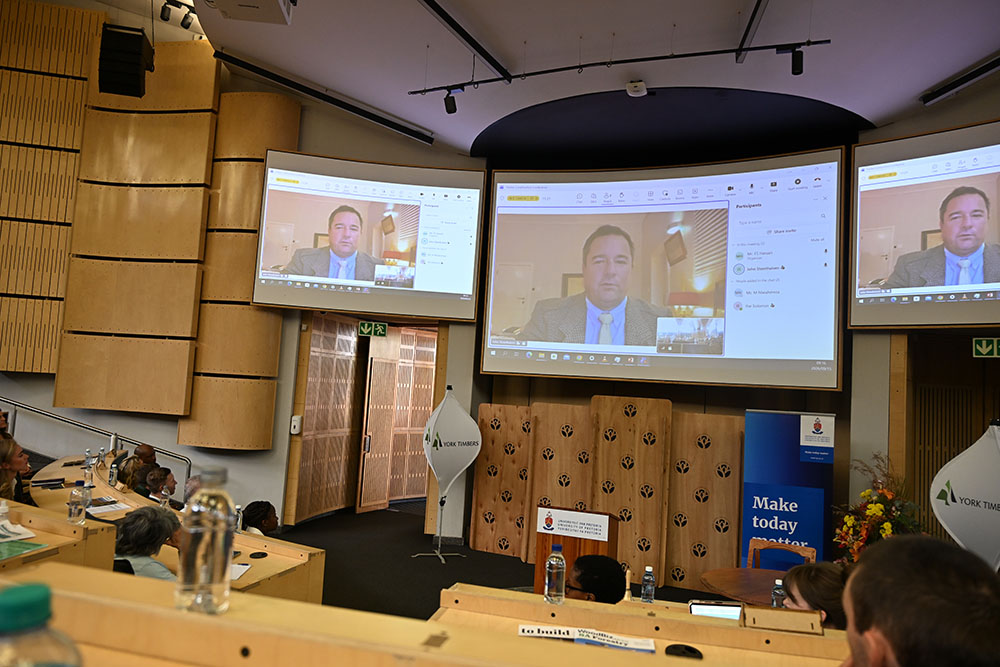
The Deputy Minister of Trade, Industry and Competition, Mr John Steenhuisen addressing the 2026 Timber Construction Conference in Pretoria.
Media Enquiries:
Bongani Lukhele – Director: Media Relations
Tel: (012) 394 1643
Mobile: 079 5083 457
WhatsApp: 074 2998 512
E-mail: BLukhele@thedtic.gov.za
Issued by: The Department of Trade, Industry and Competition (the dtic)
X: @the_dtic
Facebook: https://www.facebook.com/thedti?mibextid=ZbWKwL
YouTube: https://www.youtube.com/@thedtic
Website: https://www.thedtic.gov.za/
Share this:
