
The Acting Chief Director of Special Economic Zones (SEZs) at the Department of Trade, Industry and Competition (the dtic), Mr Shaun Moses says as green hydrogen development moves towards commercialisation, SEZs can play an expanded role by creating integrated and investment ready environment for hydrogen production, beneficiation, manufacturing, logistics and associated value chains. Moses was speaking during the Africa Green Hydrogen Summit panel discussion focusing on the SEZs Policy in Cape Town.
According to Moses, the SEZ programme provides an important industrial policy framework to support manufacturing, investment attraction and industrial growth.
“Beyond fiscal incentives, the competitiveness of green hydrogen projects will depend on a combination of enabling factors, including access to purpose-built infrastructure, renewable energy and transmission, ports and logistics, industrial clustering, streamlined regulatory processes and effective coordination across national, provincial and municipal institutions,” said Moses.
He added that SEZs can serve as strategic drivers for integrating these conditions and reducing project development risks.
“Key elements of enabling SEZs environment include targeted fiscal and investment incentives to reduce capital and operating costs and improve project competitiveness, purpose-built infrastructure and industrial clustering, including energy, water, logistics, port and rail infrastructure and efficient regulatory and investment facilitation mechanisms, including one-stop shops and coordinated permitting processes,” he said.
Moses explained that the current SEZs incentive framework provides its strongest value through a combination of the 15% corporate tax rate, customs and Value-Added Tax (VAT) benefits, and the ability to develop industrial clusters around green hydrogen, green ammonia, green steel and other downstream industries.
“Importantly, this aligns with South Africa’s Industrial Development Strategy, which seeks to drive industrialisation and beneficiation, and our Spatial Industrial Strategy, which aims to develop new industrial growth nodes linked to ports, renewable energy resources and logistics corridors. If South Africa is serious about becoming a global green hydrogen player, we must move beyond incentives alone,” he said.
Moses added that the next-generation opportunity is to move from a generic SEZs model to a Hydrogen Industrial Hub model, combining SEZ benefits with production incentives, infrastructure guarantees, accelerated permitting, and localisation support.
“That would position South Africa not only as a producer of green hydrogen, but as a globally competitive manufacturing and beneficiation platform for the entire hydrogen value chain,” he said.
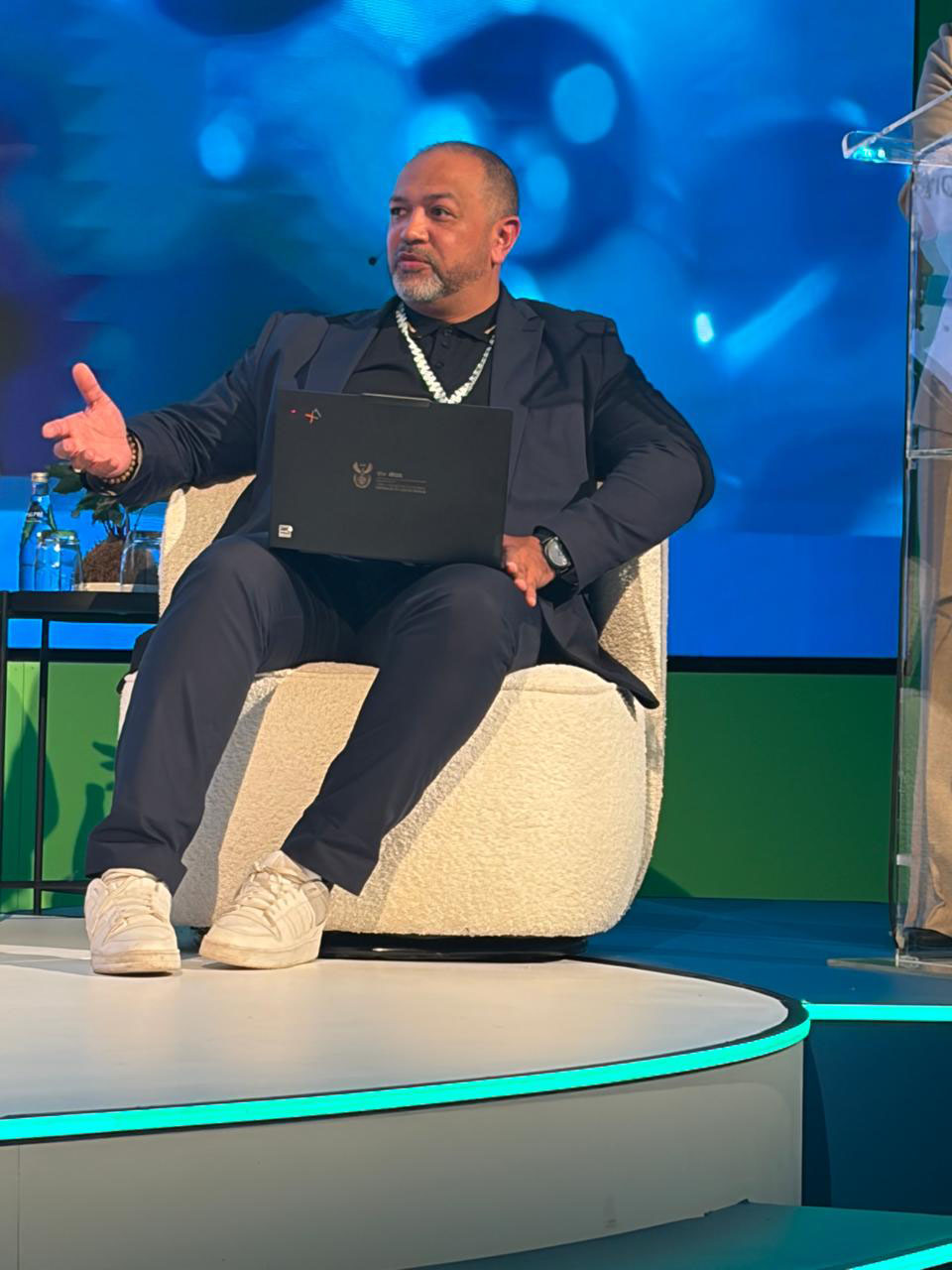
The Acting Chief Director of Special Economic Zones at the Department of Trade, Industry and Competition (the dtic), Mr Shaun Moses speaking at the Africa Green Hydrogen Summit in Cape Town, Western Cape.
Media Enquiries:
Bongani Lukhele – Director: Media Relations
Tel: (012) 394 1643
Mobile: 079 5083 457
WhatsApp: 074 2998 512
E-mail: BLukhele@thedtic.gov.za
Issued by: The Department of Trade, Industry and Competition (the dtic)
X: @the_dtic
Facebook: https://www.facebook.com/thedti?mibextid=ZbWKwL
YouTube: https://www.youtube.com/@thedtic
Website: https://www.thedtic.gov.za/
Share this:
