
The Deputy Minister of Trade, Industry and Competition, Mr Zuko Godlimpi, has hailed the signing of Phase Two of the Sugarcane Value Chain Master Plan to 2030 and emphasised that it will focus on product diversification and securing jobs. Deputy Minister Godlimpi was addressing stakeholders and journalists during the signing ceremony in Durban, KwaZulu-Natal, today.
Phase Two intends to build on the progress made under Phase One, which ensured the stability of the industry, which had faced an existential crisis prior to the introduction of the Master Plan in November 2020. Transitioning from a sugar-based to a sugarcane-based industry is one of the apex priorities or objectives of Phase Two of the Master Plan.
“We are now reinvesting in existing capabilities and advancing the technologies needed to minimise value losses and improve efficiency. There is also a need to reposition sugarcane from being seen purely as an agricultural product to an engineered one, which can drive future employment opportunities and enable progress toward more sophisticated outputs such as fuel resources,” said Deputy Minister Godlimpi.
Deputy Minister Godlimpi added that the signing ceremony marked a significant moment, signaling the end of the notion that the sugar industry was forever in perennial crisis. He stressed that the Department of Trade, Industry and Competition (the dtic) was committed to accelerating growth and improving diversification through social impact.
“I also challenge the industry to aim for significant growth, and target an increase in South Africa’s domestic fuel production from 40% to 55% through substantial investment in technology and operations. There is a need for government and social partners to improve their value offering to make the sector productive and effective,” he emphasised.
Godlimpi pointed out that the retention of black small-scale growers are critical element of the Master Plan.
“Phase One has reinforced small-scale growers as being foundational to the industry. The retention of black small-scale growers is also a critical of the master plan. Phase Two will cement this position and ensure the sustainability these growers,” said Godlimpi.
Deputy Minister Godlimpi also shared insights from the week spent visiting different sugar mills in the province, which sparked ideas for the future of the sugar industry.
“The purpose of the visit was to assess readiness for the upcoming crushing season, a critical factor for both industry productivity and overall business viability. I am excited about the ideas that emerged during these visits and the potential they hold for future success in the sugar industry. The week proved highly insightful and has left me with a more optimistic outlook on the industry’s future,” added Deputy Minister Godlimpi.
Speaking at the Master Plan Signing Ceremony, the Acting Chair of the South African Sugar Association (SASA), Mr Rex Talmage, said the resolution of several outstanding matters, in their last Executive Oversight Committee, saw the social partners engage seriously with commitment and genuine goodwill to find common ground. “We are deeply encouraged by the active involvement of organised labour in this process. Their presence at this table is not a courtesy but it is a necessity. Because what we are building as an industry rests on a powerful truth of the whole is greater than sum of its parts,” said Talmage.
Talmage said at the end of February 2026, deep-sea imports exceeded 197 000tons for the 2025/26 season representing revenue losses of approximately R1.5 billion. “These are not abstract figures, they represent the one million livelihoods that depend upon this industry. With the Dollar-based Reference Price unchanged since 2018, now eight years, the ability of the Master Plan to deliver on its promise is fundamentally constrained. An adequately calibrated reference price is not a narrow tariff matter, but it the enabling condition upon which every other commitment we make today depends,” he said.
Talmage added that SASA recognised the complexity of the process and respected the institutional rigour that International Trade Administration Commission of South Africa (ITAC) brought to the matter pertaining to its self-initiated investigation into the adequate level of the tariff.
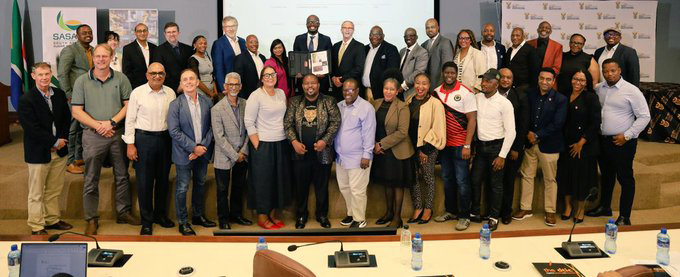
The Deputy Minister of Trade, Industry and Competition, Mr Zuko Godlimpi, with stakeholders during the Phase Two Sugar Industry Master Plan ceremony in Durban, KwaZulu-Natal.

The Deputy Minister of Trade, Industry and Competition, Mr Zuko Godlimpi, addressing stakeholders in Durban, KwaZulu-Natal.
Enquiries
Phumzile Kotane – Media Relations
Tel: (012) 394 1147
Mobile: 071 462 8246
WhatsApp: 071 462 8246
E-mail: PKotane@thedtic.gov.za
OR
Cedric Mboyisa
Group Communications and Media Manager
Tel: 031 508 7023
Mobile: 083 992 5100
Cedric.Mboyisa@sasa.org.za
Share this:
