The Deputy Minister of Trade, Industry and Competition, Alexandra Abrahams, has participated in the National Council of Provinces’s (NCOP) “Taking Parliament to the People” programme in the Matlosana Municipality in the North West province taking place from 12 to 15 May 2026 under the theme: “Ensuring a people-centred local government towards building better communities”.
As part of the programme, she represented the Department of Trade, Industry and Competition (the dtic) during the Public Hearings on Health and Economic Development.
The NCOP initiative provides communities with a direct platform to engage government on service delivery challenges, economic development priorities, infrastructure constraints, and opportunities for inclusive growth. The programme includes public hearings, oversight visits, and engagements with local stakeholders across a range of sectors including health, economic development, mining, agriculture, infrastructure, and job creation.
Deputy Minister Abrahams said the engagement comes at a critical moment for communities facing high unemployment, weak local economic growth, and rising pressure on households and small businesses which was evident by the contributions made by members of the public.
“Economic growth must become tangible in the daily lives of South Africans. Communities want to see jobs, functioning local economies, safer business environments, and practical support for entrepreneurs who are trying to build sustainable businesses,” said Deputy Minister Abrahams.
“the dtic’s role is to help create the conditions for investment, industrial expansion, and enterprise development. That requires government to focus on implementation, reduce barriers to growth, and ensure that support programmes reach businesses and communities more effectively.”
“It is government’s responsibility is to ensure an enabling and sustainable environment for the private sector and business community to expand and create jobs. This will require a whole of government approach to turbocharge our economy by intervening in the structural constraints and barriers holding our economy back.”
During the engagement, the Deputy Minister outlined a number of the dtic’s industrial financing and incentive programmes aimed at supporting manufacturing, agro-processing, industrialisation, services exports, infrastructure investment, and small business development. These include the Manufacturing Support Programme, Agro-Processing Support Scheme, Automotive Investment Scheme, Black Industrialists Scheme, Export Marketing and Investment Assistance Scheme, and the Global Business Services Incentive.
the dtic’s incentive programmes are designed to stimulate investment, improve competitiveness, support localisation, expand exports, and create employment opportunities across labour-intensive sectors of the economy.
Deputy Minister Abrahams also highlighted the importance of ensuring that economic support programmes deliver measurable outcomes and meaningful opportunities for communities.
“Public resources must produce measurable impact. South Africans are entitled to expect value for money, better coordination, and programmes that create sustainable economic opportunities rather than dependency,” said Deputy Minister Abrahams.
“A capable developmental state must work with the private sector, investors, entrepreneurs, and local communities to unlock growth. Government cannot substitute for economic activity. Its role is to create an enabling environment where businesses can invest, expand, and employ more people.”
The Deputy Minister highlighted the role played by development finance institutions and enterprise support mechanisms operating within the North West Province, including support for tourism enterprises, small businesses, manufacturing activities, and township economic development initiatives. The National Empowerment Fund (NEF) has invested approximately R503 million in the province since inception, supporting more than 2 200 jobs, while the Industrial Development Corporation (IDC) has similarly maintained a significant provincial footprint, with approximately R5 billion in exposure in the North West across a range of productive sectors.
She said sustained economic growth and job creation will depend on stronger implementation, reducing red-tape, policy certainty, infrastructure delivery, and deeper collaboration between national, provincial, and local government.
She further noted; “In response to the complaints raised about delays in the issuing of clearance and other compliance certificates at various levels of government, in particular municipal level, the dtic is developing the Fusion Center – a live dashboard to track investment projects and were in the implementation process these projects get delayed so the dtic can intervene as these projects are essential to deliver jobs for local communities and deliver dignity.”
“We need a more practical and outcomes-focused approach to economic development. Communities do not experience policy through strategy documents. They experience it through whether investment arrives, whether businesses survive, whether infrastructure functions, and whether young people can find work,” she said.
“The NCOP’s Taking Parliament to the People programme is important because it creates direct accountability between government and the communities we serve. It also provides an opportunity to identify practical obstacles to growth and ensure that public institutions respond more effectively to local realities.”
Deputy Minister Abrahams emphasized; “The North West Province has the potential to contribute meaningfully to South Africa’s economic growth. What is required is partnership, urgency and we need to move past talking and start doing.”
She concluded by acknowledging government must do better and thanked all the speakers for holding their government accountability.
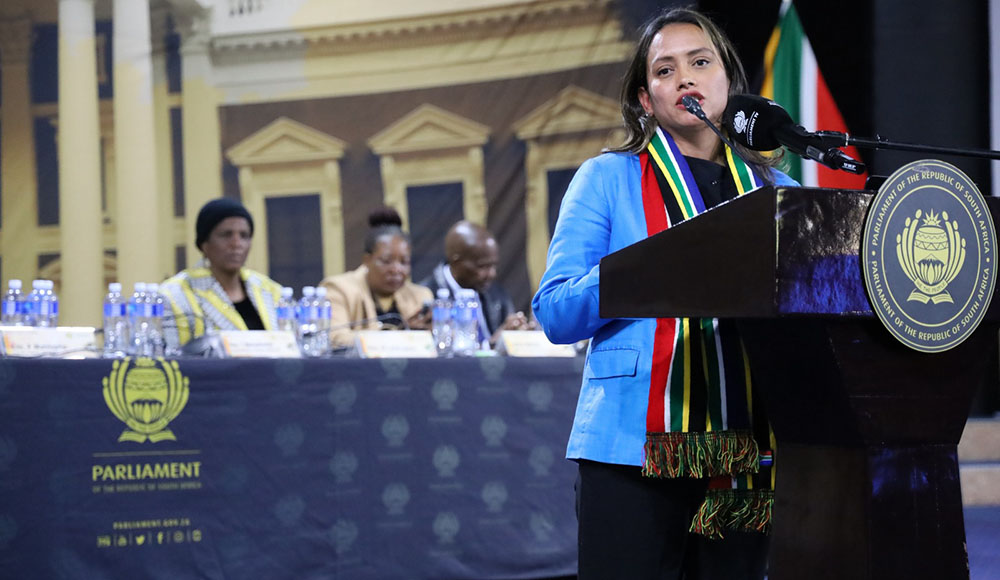
The Deputy Minister of Trade, Industry and Competition, Ms Alexandra Abrahams engaging attendees National Council of Provinces’s (NCOP) “Taking Parliament to the People” programme in the Matlosana Municipality in the North West province.
Media Enquiries:
Grant Caswell – Head of Office to Deputy Minister Abrahams
Mobile: 076 811 6655
WhatsApp
E-mail: gcaswell@thedtic.gov.za
OR
Bongani Lukhele – Director: Media Relations
Tel: (012) 394 1643
Mobile: 079 5083 457
WhatsApp: 074 2998 512
E-mail: BLukhele@thedtic.gov.za
Issued by: The Department of Trade, Industry and Competition (the dtic)
X: @the_dtic
Facebook: https://www.facebook.com/thedti?mibextid=ZbWKwL
YouTube: https://www.youtube.com/@thedtic
Website: https://www.thedtic.gov.za/
Share this:
